

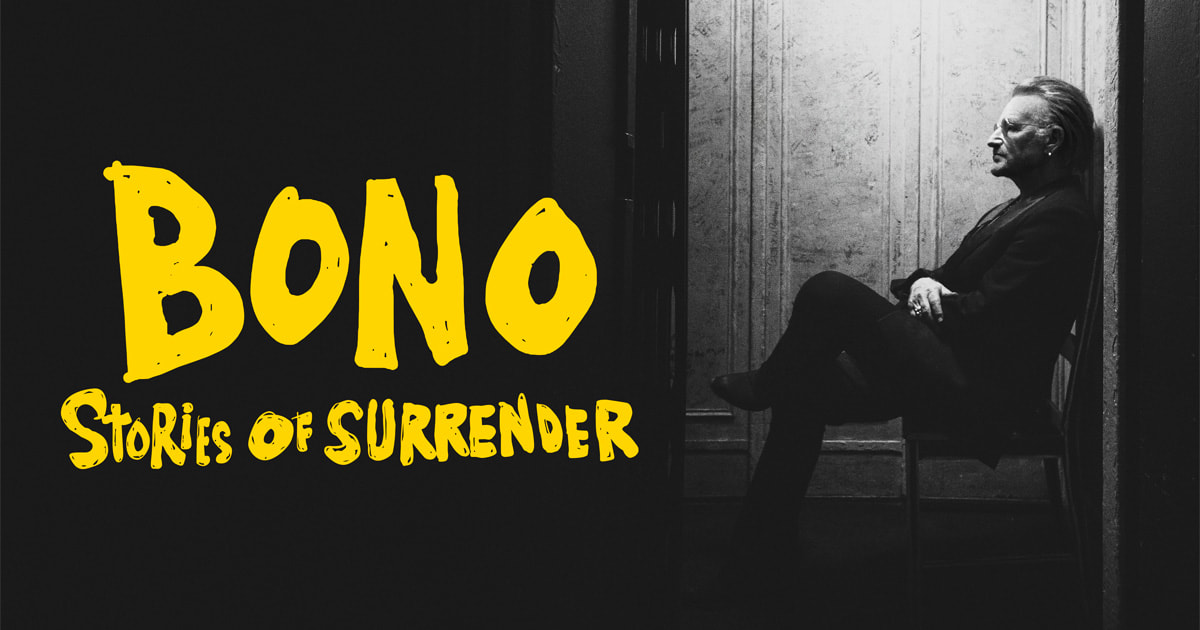
cinematographer Erik Messerschmidt sat down with AMFM Magazine’s Paul Salfen to discuss his work on Bono: Stories of Surrender, a vivid reimagining of Bono’s critically acclaimed one-man stage show, now streaming on Apple TV+. A 2025 Creative Arts Emmy nominee for Outstanding Technical Direction and Camerawork for a Special, Messerschmidt’s artistry brought an intimate and striking black-and-white lens to Bono’s deeply personal performance, blending words, music, and mischief to tell the story of a son, father, husband, activist, and rock star.
Messerschmidt’s journey to this project began with a call from director Andrew Dominik, with whom he had previously collaborated on Mindhunter. “I was thrilled when Andrew called me to do the movie,” Messerschmidt recalls, his enthusiasm palpable even through the heat advisory gripping Texas. A self-professed U2 and Bono fan, he was immediately captivated by Dominik’s vision to capture the show in stark black-and-white, a bold choice that would strip away distractions and focus on the raw emotion of Bono’s storytelling. “I hadn’t read the book at the beginning,” Messerschmidt admits, referring to Bono’s memoir that inspired the show. “But when I did, I realized this was quite rare—a chance to capture someone in a vulnerable place, revealing their life to the audience.”
The film, which includes never-before-seen footage from the Stories of Surrender tour, is as much a concert film as it is a documentary, breaking conventions by placing cameras right on stage, mere inches from Bono’s face. “We’re going to break the rules of concert films,” Messerschmidt explains, echoing Dominik’s directive to capture “the truth” of Bono’s performance. This truth lies in the personal stories Bono shares—tales of his father, his childhood struggles, and the joys and fears that have shaped him. The close-up camerawork allows viewers to feel the weight of every word, every note, every glance. “The camera captures things differently when it’s 18 inches from his face,” Messerschmidt says. “It’s about bringing the audience behind the curtain, breaking that safe wall between performer and viewer.”
This intimacy is amplified by the film’s black-and-white aesthetic, a decision championed by both Dominik and Bono himself. “It wasn’t necessarily a popular choice,” Messerschmidt notes, acknowledging the resistance they faced. “But Bono believed in it. He said, ‘This is what we’re doing.’” The monochrome palette distills the visuals to their essence, emphasizing Bono’s expressions and the quiet power of his stories. “Being a performer on stage can be a lonely place,” Messerschmidt reflects. “By limiting distractions—colors, everything—you make it about his face, his words, and that simplicity was the right choice.”
Messerschmidt’s collaboration with Bono revealed a man who defies the trappings of celebrity. Paul Salfen shares a personal anecdote from years ago, when he encountered Bono on a New York street after a U2 concert. Rather than brushing him off, Bono stopped to ask about Salfen’s experience at the show—where he sat, if he could see everything, if he enjoyed the song selection. Messerschmidt experienced a similar warmth. “I found Bono to be incredibly generous, considerate, thoughtful, and curious,” he says. “He was interested in how we were lighting it, photographing it, and he championed the black-and-white approach.” Bono’s humility and care for those around him—his crew, his friends, his family—left a lasting impression. “He cares deeply about humanity,” Messerschmidt adds, “and that rubs off.”
For Messerschmidt, whose career includes an Oscar for Mank and work with directors like David Fincher and Ridley Scott, Bono: Stories of Surrender was a unique privilege. “The documentary process is the purest type of filmmaking,” he says. “Helping someone tell their story in such a personal way is a gift.” His background in photography, sparked by an old Nikon gifted by his mother at age six, informed the film’s stunning visuals, where any frame could be paused to reveal a portrait-like composition. Yet, Messerschmidt values the collaborative nature of filmmaking over the solitary act of photography. “I like helping a director make their movie,” he says. “The communal aspect of the movie set, the relationships with actors and crew—that’s what I love.”
Reflecting on his career, Messerschmidt points to a pivotal “Hail Mary” moment when Fincher tapped him for Mindhunter despite his limited experience as a cinematographer. “It was intimidating,” he admits, “but I said, ‘I’m going to go for it.’ That decision changed my life.” Now, as a father to a young daughter, Messerschmidt finds new motivation in his work. “If I’m going to be away for 14 hours, it has to be worth it,” he says. “I want her to look at what I’ve made and say, ‘He was gone that day, but look what he created.’”
For aspiring filmmakers, Messerschmidt’s advice is simple yet profound: “Be prepared to fail, and go for it.”
He urges creators to prioritize their vision over external validation. “It’s easy to make stuff everyone else likes, but it’s never really yours. Stand behind your work, make it with intention, and that’s when it works best.”
As Messerschmidt looks ahead, he’s fresh off shooting The Dog Stars with Ridley Scott and is now working on a new project with Fincher, a spiritual successor to Once Upon a Time in Hollywood. Yet, Bono: Stories of Surrender remains a standout in his oeuvre—a testament to the power of bold choices, intimate storytelling, and the courage to capture truth. For viewers, it’s a chance to see Bono as never before: raw, reflective, and profoundly human, framed by Messerschmidt’s masterful lens.
